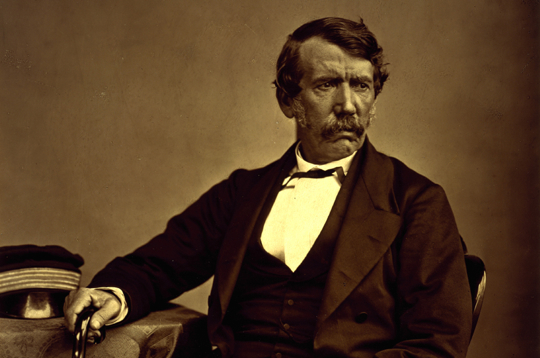
"I Never Made A Sacrifice"


David Livingstone
Today is David Livingstone’s birthday. He was born March 19, 1813. He gave his life to serve Christ in the exploration of Africa for the sake of the gospel.
On December 4, 1857, he spoke the sentence that has made the greatest impact on me. It is one of the clearest applications I have seen of Jesus’ words in Mark 10:29-30. Jesus said,
Truly, I say to you, there is no one who has left house or brothers or sisters or mother or father or children or lands, for my sake and for the gospel, who will not receive a hundredfold now in this time, houses and brothers and sisters and mothers and children and lands, with persecutions, and in the age to come eternal life.
Here is what Livingstone said to the Cambridge students about his “leaving” the benefits of England:
For my own part, I have never ceased to rejoice that God has appointed me to such an office. People talk of the sacrifice I have made in spending so much of my life in Africa. . . . Is that a sacrifice which brings its own blest reward in healthful activity, the consciousness of doing good, peace of mind, and a bright hope of a glorious destiny hereafter? Away with the word in such a view, and with such a thought! It is emphatically no sacrifice. Say rather it is a privilege. Anxiety, sickness, suffering, or danger, now and then, with a foregoing of the common conveniences and charities of this life, may make us pause, and cause the spirit to waver, and the soul to sink; but let this only be for a moment. All these are nothing when compared with the glory which shall be revealed in and for us. I never made a sacrifice.
(Cited in Samuel Zwemer, "The Glory of the Impossible" in Perspectives on the World Christian Movement, Ralph Winter and Stephen Hawthorne, eds. [Pasadena: William Carey Library, 1981], p. 259. Emphasis added.

God's Employment Office Is Open

Did you know that there there can be zero-percent unemployment for the Christian? There are more than enough exciting work opportunities available in the Kingdom Job Bank.

There’s something positive about this current financial cataclysm. Here’s what I mean: Remember what happened on the day Stephen was stoned?
“A severe persecution broke out against the church in Jerusalem, and all except the apostles were scattered, and those who were scattered went on their way proclaiming the message of good news” (Acts 8:1,4). And then later, Those who had been scattered as a result of the persecution went as far as Phoenicia, Cyprus, and Antioch, speaking the message” (Acts 11:19).

In spite of Jesus’ parting “Go ye” words still ringing in their ears, most Jerusalem Christians had remained content in their home town comfort zone. What got their attention? What got them moving? What made them obedient?

Trouble. In fact, a cataclysm of persecution. They were scattered; not willingly, but in fact, the persecution “made havoc” of the church. It cost believers everything.

Cataclysm? Yes, but it was good for the church and good for the Gospel because believers began doing what Jesus had told them to do — “They that were scattered went everywhere preaching the Word.”

Our present cataclysm is not the same as this but it has the same potential. Could it possibly even reset the direction of our lives so that 2500+ languages might have a Bible? Or a flood of Christian workers materialize? Or millions of unreached people hear of Christ for the first time? And could it mean that even short term mission agencies will have a surplus of workers?

It all can happen once we are freed from hindrances and delivered from our excuses. It doesn’t require a cataclysm to do this but such an upheaval sure helps create a situation where it is more likely to be done.

None of us really want the losses caused by this financial downturn, but here it is. Now what? Well, remember . . .

The Kingdom Job Bank is open and they are hiring.

Must You Hear the Gospel To Be Saved?

This book is coming out in mid-year. It is certainly timely and could possibly be a part of the BIG motivation the Church needs - or individuals in the church need - to get off dead center and into God's plan for reconciling the lost world to Himself.
In our shrinking, pluralistic world, the belief that Jesus is the only way of salvation is increasingly called arrogant and even hateful. In the face of this criticism, many shrink back from affirming the global necessity of knowing and believing in him. (From the advance publication materials).
In Jesus: the Only Way to GodJohn Piper offers a timely plea for the evangelical church to consider what is at stake in surrendering the unique, universal place of Jesus in salvation.
Buy this book in advance by calling 888.346.4700.
You will receive your copy after it is released in July.
Price at Desiring God: $4.99
List Price: $5.99

One Way A Very Public Figure Spoke

Charles Malik


On September 13, 1980, Charles Malik gave an address called “The Two Tasks” at the opening of the Billy Graham Center at Wheaton College. He was the Lebanese Ambassador to the United States. The message was so seminal that in 2006 (his centenary) it was republished with a collection of essays built around it. What strikes us as he stands to speak is the personal dimension and the public scope of his Christian commitment.

I speak to you as a Christian. Jesus Christ is my Lord and God and Savior and Song day and night. I can live without food, without drink, without sleep, without air, but I cannot live without Jesus. Without him I would have perished long ago. Without him and his church reconciling men to God, the world would have perished long ago. I live in and on the Bible for long hours every day. The Bible is the source of every good thought and impulse I have. In the Bible God himself, the Creator of everything from nothing, speaks to me and to the world directly, about himself, about ourselves, and about his will for the course of events and for the consummation of history. And believe me, not a day passes without my crying from the bottom of my heart, ‘Come, Lord Jesus.

Charles Malik (1906-1987), Lebanon's ambassador to the USA (1945-55), President of the UN General Assembly (1958-59), professor of philosophy at the American University of Beirut (1962-76). Quoted from “The Two Tasks” in The Two Tasks of the Christian Scholar: Redeeming the Soul, Redeeming the Mind, eds. William Lane Craig and Paul M. Gould (Wheaton, Illinois: Crossway Books, 2007), p. 55.