Showing posts with label Missionary. Show all posts

Heartbeat

I do not count my life . . . as precious to myself,
if only I may finish my course and . . . testify to the gospel of the grace of God. — Acts 20:24

Quoting someone: “The world cannot be reached in absentia. Sooner or later somebody has to go.” But now it's time to add, “. . . and sooner or later somebody has to stay there!”

Going means little unless missionaries stay where they go. That should be obvious, but herein lies a possible danger. It is the idea that short-term—that is short-stay missions is some sort of magical, new-found key for reaching the world for Christ. It is the idea that individuals and churches have somehow discharged their Great Commission responsibility with their short-term people and programs. There are now those churches who have almost completely stopped sending or supporting career missionaries opting instead for short-termers.

In reality, short-term missions is not even the key for evangelizing Jamaica! And Jamaica is reached a lot more easily than most. Consider that short-term missionaries are not even an option for many of the unreached three billion people in almost 7,000 people groups. And with many hidden away in approximately 60 “closed” countries, we know that these will remain in darkness without something more—a lot more.

That “something more” is people who finish the course . . . people who begin at the starting line and go all out until they complete the race. They will go by every available means and will stay there, all for the main purpose of testifying to the gospel.

TEAMS in Jamaica is primarily about full-time, lifelong, missionary presence. This describes each of our missionaries. By God’s grace these and those who join them will indeed give their lives for the cause of the gospel. May some who read these lines be among them.

---------------
by Ray Shive. Taken from the current Fall 2011 TEAMS for Medical Missions Vital Signs newsletter. TEAMS missionaries serve in Jamaica, West Indies to strengthen the church through . . . 

Teaching  ~ Evangelism ~ Aid and ~ Medical Services.

Read the entire issue at http://www.t4mm.org/Newsletters.lsp

Train the Untrained to Reach the Unreached


I have added the following to this blog because it poses a great question. It is a Priority-of-God's-Word question placed in a very strategic Great Commission context. Darren Carlson of Training Leaders International asks:

Why take the time train people to be faithful teachers of Scripture when untold millions are going to hell? 

That is a helpful question for me to wrestle through as I spend a good deal of my time training international pastors and church leaders.
When most people recount the Great Commission, they usually say something to the effect of, “We must go to all the nations and share the gospel.”  To that I say amen!  But then something strange happens — we stop. So what about the command in Matthew 28:20 to teach? It is what David Sills has called the Great Omission.

Reached Can Move Backwards to Unreached

If we are not careful, those precious people groups and nations that we have deemed to be reached will be moved back to unreached. Why? Because in our need for speed, we have not helped to deepen the roots of faith, and instead of trees firmly planted by streams of water, the church is blown over with just the slightest amount of false teaching. The supposed explosion of Christian faith around the world has left us with lots of Christians and very few trained pastors.
When I say “trained,” I do not mean “gone to school.” Theological training is just part of a discipleship process, and for a pastor it means learning to rightly handle the Bible. Many pastors have been trained by sitting in jail cells, but they still don’t know their Bible. Or they know a lot of Bible verses, but have no idea how they fit together. So this particular training that is needed is deliberate theological education that is God-centered, Christ-exalting, and Bible-saturated.
I have met many zealous Christians who are clearly gifted evangelists but who hardly know anything about the Bible. I have heard of pastors who asked my friend, “When was Jesus converted?” I have heard the strangest sermons you can imagine — no where close to anything Christian. I have a good friend from West Africa whose country is no longer on the unreached list, and yet he admits he knows only a handful of churches in the entire nation where the gospel is faithfully preached.

Four Ways to Be Strategically Involved

As someone who is currently giving his life to training pastors internationally, I'm convinced of the strategic role that training plays in reaching the unreached. Here are a few thoughts about how the Western Church can be involved:
  1. As we are deeply concerned in going to the unreached peoples of the earth, we should recognize the unique impact of non-Western missionaries and seek to train them. These untrained messengers of the gospel often know at least five languages — they just need theological grounding. What is the main point of the text? How does the whole Bible fit together? They need to see where they fit in God’s story of redeeming the nations and we should be committed to serving them.
  2. Send unemployed PhD-holders to the international classroom. Our seminaries and graduate schools stock Starbucks and UPS with highly competent minds. Might instead we consider our brothers overseas and ask, "How will they teach faithfully if they are not trained? And how will they be trained without someone teaching? And how are we to teach unless we go?"
  3. Send your pastor overseas twice a year to work with another organization that is providing theological education to international pastors and church leaders. 
  4. Send your pastor overseas for good and free up pastoral positions for seminary graduates. We need men who have been in pastoral ministry to go. Guys in seminary need a place to land. Makes sense to me!
The end goal is to strengthen the existing church internationally with deep truth that will sustain them and equip them to reach the unreached people groups we long to see worship Jesus. 
Darren Carlson is the founder and president of Training Leaders Internationala ministry that mentors and sends graduate students and pastors to bring theological education around the world.

Ten Missional Prayers for the Church Today

These ten prayer themes appeared some weeks ago in a September 16, 2010 blog by Dr. James Emery White. Click here for Dr. White's blog 

Some of these so audaciously highlight the church's shameful self-centeredness, irrationality and self-delusion, shallow thinking, and general misbehavior that they almost take one's breath away! Every one of them shakes me a little but I have highlighted those that most do that:

1. That pastors would see other churches in their immediate vicinity as a co-laborer, not as the competition.

2. That members of churches would see themselves as ministers and missionaries, dying to themselves for the sake of the cause, as opposed to consumers who care most about whether they are fed, ministered to, or served themselves.

3. That parachurch organizations would be parachurch organizations - meaning serving alongside the church while giving the local church the pre-eminence it deserves - and allowing the partnership to reach its full redemptive potential in light of the biblical mandate.

4. That church planters would commit to being a) sent by a church; b) called by a community; and c) eager to go where no one has gone. Instead of a) sending themselves; b) going to where they simply desire to live; and c) remaining blind to the reality that they'll be the 11th McDonalds in a row of ten existing ones.

5. That all seminaries would remember that they exist to serve the church, and that they would serve the church to such a degree that their students would be more on fire to serve and build the local church after they have graduated than before they entered.

6. That those committed to discipleship, and rightly so, would quit pitting it against evangelism as if any emphasis on "reaching out" somehow takes away from "building up", creating a false dichotomy that doesn't exist biblically.

7. That older generations would quit worrying about whether they are being catered to sufficiently, and would become more interested in whether they are passing the baton on to the next generation that is so desperate and hungry for mentoring.

8. That the false dichotomy between a concern for personal or sexual morality, and social justice, would evaporate. Instead, that we would see that being salt and light applies to both concerns: being as concerned for a culture of divorce as much as we are for the AIDS pandemic in Africa.

9. That the pendulum between whether to share the gospel or engage in social ministry would also disappear. That we would see them not as an either-or, but a both-and; we are to give a cup of water and the bread of life, feeding both stomach and soul.

10. That we would understand that lost people are not the enemy, but instead the objects of the Father's heart - and thus, they should be the objects of ours. That we would join the Father as He sets out to find His lost sheep, search for His lost coin, and look desperately down the road for His prodigal son.

Corruption

(My brother, Dave, and a coworker are currently in Indonesia. The following two blog posts are edited emails. They are lengthy but need to be read and understood by Christians who want to think and act as would Jesus Christ. Highlighting is mine).


If you live in the west, you might think you have to deal with corruption. But you ain't seen nothin’ till you travel to other parts of the world. Here are some real instances to give you an idea of the immensity of the spiritual darkness that has engulfed just one nation – the nation of Indonesia:

 ·     Imagine that you have a serious crime problem. You call the police, unless you live in Indonesia. Even if a murder has occurred, the police will favor the person who offers the biggest bribe.

·       Imagine that you are pulled over in traffic by a cop. You must have been speeding or committed some other infraction . . . unless you live where darkness reigns. It would almost always be because the police officer is low on finances and needs to "fine" you so he can pay a bill or have some extra cash.

·       Imagine that you have to go to court and stand before a judge. You expect justice to be done. But not where it is always winter and never Christmas, because when Satan makes the rules, the person with the biggest bribe always wins.

·       Imagine that you are a college student. You enroll in a course, do assignments, take exams, and get a grade. But not in a land where every vestige of good is in the process of being squelched. Here you cannot pass a course without bribing the professor repeatedly for each exam and for a final grade (even though the professor habitually either doesn't show up for class, or shows up unprepared, or dismisses class after a brief discussion about something unrelated to the content of the course).

·       Imagine that you have completed all of your college course work. You naturally expect to graduate. Not in a land where the malevolent tyrant has been eradicating hope. After completing your college course work, you still cannot graduate unless you pay a bribe to the dean.

.·       Imagine that you are a college graduate, are sincerely motivated, and want to teach school in a needy area to help the students. You will surely find a job and the government will bend over backwards to help you . . . unless you live where despicable wickedness is the rule. Here you cannot get a teaching position without bribing the local principal. One well-meaning teacher wanted to work in a school in a poor, remote area. But first she had to pay the principal $25,000 (US dollars) just to get the job. She borrowed the money from family and friends and, on her low salary, will spend the rest of her life paying it back.

·       Imagine that you rent a house, sign a lease, and even make improvements with the owner's guarantee in writing that when the lease is up you have the first right to rent the house for another period of time. Sounds secure . . . unless you live where the father of lies has written the rules. Here no document is backed by the courts (remember the judges take bribes).

·       Imagine that you are stopped at a traffic light and a motorcycle crashes into the side of your car. The cyclist is clearly guilty and must pay his own hospital bills and your car repair bills . . . unless you find yourself at the mercy of the master deceiver. Here the person with the most expensive vehicle is assumed to have the most money and must pay all of the hospital and repair bills, regardless of guilt. If you refuse to pay, a mob will assemble and will attack you.

·       Imagine that you are a pastor and your church obtains a legal building permit and construction on your church building begins. The government would never come back to you 2 years later and revoke your permit and forbid you to worship in your facility . . . unless your church is in Indonesia where, if enough neighbors complain, the government will withdraw your building permit and mobs can come and disrupt your service and beat up the pastor.

·       Imagine that there are "Christians" in Florida who are burning Korans and you, a western missionary, are appalled at such an act and think it is utterly stupid. People around you would never automatically associate you with such insanity . . . unless you live in almost any Muslim context. There every westerner is believed to be a "Christian" who walks in lockstep with the most idiotic actions that other westerners may take against Islam. For safety, you must hide in your house and wait for days for everyone to calm down before you can reappear.

·       Imagine traffic laws . . . Oh, forget that one. The only traffic law in many parts of the world is that the first vehicle to land on a piece of pavement has the right to that spot.

This is the world that Roscoe and I have been in for only 3 days and it absolutely drives us crazy. Imagine what a God of beauty, truth, and order thinks of such a place! Imagine missionaries who have intentionally moved here to devote their lives to bringing the light of the glorious Gospel of Jesus to people crippled by darkness. Some bring wives, many bring children, and they will often spend 10, 20 or even their whole ministry lives here.

The next time you need justice and it is properly meted out . . . the next time you are promised something and the promise is made good . . . the next time a government official functions with integrity . . . the next time you are rewarded fairly for your labors . . . remember a nation of 240,000,000 people who never get to have such an experience.

And remember thousands of followers of Jesus who, for centuries, have devoted their entire lives to living in such a corrupt and difficult environment because they are passionate that representatives from every nation, tribe, tongue, and people will worship the Lamb throughout eternity.

Burning Muslim Holy Books - A Missionary Update from Indonesia

(The following is a slightly edited copy of an email received from my brother who  is currently in Indonesia doing some training of pastors).

This update goes primarily to Americans who have mainly known a world and culture that is western and formed by a Judeo-Christian worldview. Though not perfect, to us our world is orderly, just, clean, and pure. That is not the world of Indonesia. I will try to give a taste of but nothing short of visiting this country will really tell the story.

Roscoe and I find ourselves in the largest Muslim nation in the world during Ramadan, the holiest month of the Muslim calendar. We are learning a lot about Islam by being here, but how can I share those things sensitively, graciously, and yet truthfully?

Let me then say a word about the presence of Islam as a majority religion. In the west, there is a lot of confusion about Islam and the church seems to struggle with a healthy attitude towards Muslims. Much of the concern seems to come from confusion as to where our loyalties lie: are we loyal Americans or are we devoted soldiers of the cross of Christ sent on a mission to bless all the families of the earth?

It's amazing how those two thought systems get mixed in together, producing a sad theology that is effete and is incapable robust Christian discipleship.

Let me be clear: I am proud to be an American and I love my country. This is not Jane Fonda in Viet Nam denouncing the USA.

An illustration of our problem is seen in the fact that many evangelical Americans are ideologically (and even theologically) "pro-Israel" and "anti-Arab" or "anti-Palestinian". In all of that it seems to me that we have given short shrift to the theme of the Bible – that is that God intends to bless ALL of the families of the earth. We seem to have forgotten that our priority as evangelical Americans is not to advance the American flag to the four corners of the earth but to penetrate every ethnic group with the liberating truth of the Gospel of Jesus Christ.

Therfore, as Americans we may rejoice when Israel wins a war, or when America invades Iraq or Afghanistan. We may even be able to justify our feelings patriotically, theologically, or geo-politically. But what we may fail to take into consideration is that these military initiatives have huge ramifications among those national Christians and missionaries – especially if they are American - who are making great sacrifices for the spread of the Gospel.

American military initiatives are generally perceived by the Muslim world as Christians on a Crusade (with a lot of the historical baggage that carries). The result is that the work of foreign mssnries is set back. The local missionary here  told me yesterday that every time America makes a military move against an Islamic nation, Indonesian mobs roam the streets looking for foreigners to beat up. He has to stay home behind locked doors for a week or more until emotions subside.

Again, I am not taking a position here on American military initiatives; I am merely encouraging us to remember that for the Christian with a heart and mind for Christ’s global purposes there is a lot more to this than patriotic jingoism. We must thoughtfully  consider the implications of such initiatives for the more important issue of carrying out Jesus' mission.

An isolated situation like a so-called church in Florida having a day to burn the Quran may seem to many of us as some blip on the screen that is annoying but not something to be given serious thought. But the rioting this week here in the capital, Jakarta, where Molotov cocktails are being thrown at the US embassy to protest the Quran burning, should convince us that the Muslim world is watching this situation and is assuming that this incident reflects the deep animus of ALL Americans toward Muslims as people.

These days in Indonesia has told me that there is a more significant issue confronting our world than planes being flown into towers, road bombs killing innocent bystanders, human bombs walking into restaurants and killing people, and Al-Qaeda spawning terrorism around the globe. All of those are very important being also terribly wrong, but there is something that trumps all of that.

What could be more important? It is the deconstructing of the evil system of religion and worldview that has spiritually paralyzed a huge percentage of our world's population. That is the real concern, and there is a loathsome spiritual being named Satan who gloats over his conquest of so many creatures created in God's image. He is our enemy, infinitely more so than even Osama bin Laden.

Satan has shrewdly engineered a religious system that is so evil, so despicable, that it can completely corrupt every part of a culture where it prevails and can totally immobilize the capacity of the people to think clearly or to respond to truly Good News. This is truly worthy of our concern, sadness, indignation, and yes, anger.

But make sure that your anger is not misplaced or misdirected. Transform it into prayer and action that can be translated into a direct assault of the Kingdom of God against this vile kingdom of darkness that holds people in its disgusting grip.

"How few there are who die so hard."

The Difficult Death of Adoniram Judson

Yesterday (April 12, 2010) marked the 160th anniversary of the death of Adoniram Judson, America's first foreign missionary. For 38 years—through imprisonment, torture, illness, deep depression, isolation from family and friends, and the loss of two wives and numerous children—he suffered to bring the gospel to the unreached peoples of Burma.


At age 61 he fell ill for the last time. John Piper recounts those final days:
The only hope was to send the desperately ill Judson on a voyage. On April 3, 1850 they carried Adoniram onto the Aristide Mariebound for the Isle of France with one friend, Thomas Ranney, to care for him. In his misery he would be roused from time to time by terrible pain ending in vomiting. One of his last sentences was: "How few there are who . . . who die so hard!"
At 15 minutes after 4 on Friday afternoon April 12, 1850 Adoniram Judson died at sea, away from all his family and Burmese Church. That evening the ship hove to.
"The crew assembled quietly. The larboard port was opened. There were no prayers. . . . The captain gave the order. The coffin slid through the port into the night" (To the Golden Shore, p. 505).
He died in obscurity, but to this day the fruit of Judson's life and death proves the promise Jesus gave in John 12:24: "Truly, truly, I say to you, unless a grain of wheat falls into the earth and dies, it remains alone; but if it dies, it bears much fruit." As Piper observes,
Today it is estimated that the Myanmar (Burma's new name) Baptist Convention to be 3,700 congregations with 617,781 members and 1,900,000 affiliates—the fruit of [Judson's] dead seed.
What significance does this have for us today? Piper asks the hard question, especially of pastors:
Are you sure that God wants you to be a pastor in this comparatively church-saturated land? Or might he be calling you to fill up what is lacking in the sufferings of Christ, to fall like a grain of wheat into some distant ground and die, to hate your life in this world and so to keep it forever and bear much fruit?
[...]
The question, brothers, is not whether we will die, but whether we will die in a way that bears much fruit.
* * *
Read or listen to the rest of John Piper's biography of Judson.

"I Never Made A Sacrifice"


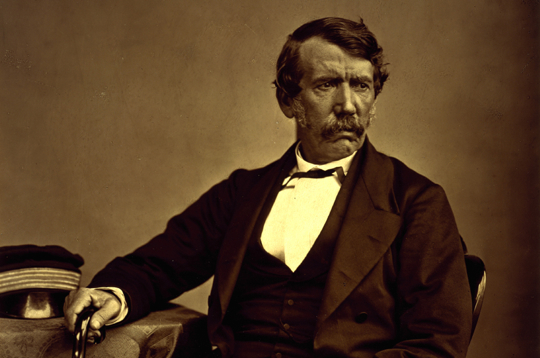
David Livingstone
Today is David Livingstone’s birthday. He was born March 19, 1813. He gave his life to serve Christ in the exploration of Africa for the sake of the gospel.
On December 4, 1857, he spoke the sentence that has made the greatest impact on me. It is one of the clearest applications I have seen of Jesus’ words in Mark 10:29-30. Jesus said,
Truly, I say to you, there is no one who has left house or brothers or sisters or mother or father or children or lands, for my sake and for the gospel, who will not receive a hundredfold now in this time, houses and brothers and sisters and mothers and children and lands, with persecutions, and in the age to come eternal life.
Here is what Livingstone said to the Cambridge students about his “leaving” the benefits of England:
For my own part, I have never ceased to rejoice that God has appointed me to such an office. People talk of the sacrifice I have made in spending so much of my life in Africa. . . . Is that a sacrifice which brings its own blest reward in healthful activity, the consciousness of doing good, peace of mind, and a bright hope of a glorious destiny hereafter? Away with the word in such a view, and with such a thought! It is emphatically no sacrifice. Say rather it is a privilege. Anxiety, sickness, suffering, or danger, now and then, with a foregoing of the common conveniences and charities of this life, may make us pause, and cause the spirit to waver, and the soul to sink; but let this only be for a moment. All these are nothing when compared with the glory which shall be revealed in and for us. I never made a sacrifice.
(Cited in Samuel Zwemer, "The Glory of the Impossible" in Perspectives on the World Christian Movement, Ralph Winter and Stephen Hawthorne, eds. [Pasadena: William Carey Library, 1981], p. 259. Emphasis added.