Showing posts with label culture. Show all posts

No Offense

by Dr. Dean Curry. Evangelicals have grown not only more tolerant, but also more tolerable. Is it possible, however, to be too inoffensive? One can possibly anticipate the conclusion to be reached, but the way Dr. Curry gets there certainly increases it's force. Read more challenging stuff like this at the evangelical portal of www.patheos.com.
~~~~~~~~~~~~~~~
Recent controversies surrounding Jim Wallis's "What Would Jesus Cut?" campaign, as well as Rob Bell's new book Love Wins, are more evidence that today's evangelicalism is notably different than yesterday's evangelicalism. The markers of contemporary evangelicalism are harder to generalize about than they were thirty or forty years ago. Whether the issues involve theology, politics, or personal morality, today's evangelicals are more diverse in their viewpoints and less likely than their predecessors to draw non-negotiable lines in the sands of culture.
University of Virginia sociologist James Davison Hunter alerted us to these significant changes way back in 1987 in his book, Evangelicalism: The Coming Generation. While Hunter's most recent book, To Change the Worldhas received considerable attention among Christians, revisiting his earlier work with nearly a quarter-century of hindsight is an especially enlightening experience, and not just because the author was so spot on in plotting the trajectory of American evangelicalism. Drawing upon an early 1980s survey project that targeted "the coming generation" of evangelical leaders—i.e., students at evangelical colleges and seminaries—Hunter anticipated, among other things, that a social agenda would slowly supplant traditional evangelical spiritual concerns. Regarding this shift, Hunter concluded in 1987 that "the significance of this trend is highlighted by the precedent set by liberal Protestant theology in the twentieth century, where the Social Gospel achieved proportions unintended by its original advocates."
Apart from his prescience in this area, Hunter's analysis is perhaps most useful in helping us understand the reasons for change within evangelicalism. Of particular note is Hunter's insightful parsing of the dimensions of "civility," one of modernity's unassailable innovations. The essence of civility is tolerance, arguably the primordial concept of our post-modern age, and a habit now widely embraced by evangelicals. But there is another dimension to civility that Hunter identifies as the inversion of tolerance, namely tolerability, and it is this side of civility that Hunter argues is key to understanding the dynamics of transformation that have taken place within American evangelicalism.
The ethic of civility requires not only that individuals be tolerant of others; it also requires that they must be tolerable to others. The implications of this ethic of "studied moderation" are clear: "Convictions are to be tempered by 'good taste' and sensibility. It is an ethic which pleads 'no offense.' The greatest breach of these norms is belligerence and divisiveness; the greatest atrocity is to be offensive and thus intolerable." The appropriation of both dimensions of civility—tolerance and tolerability—is a major reason why the boundaries of evangelical beliefs have become increasingly fuzzy and uncertain. Besides being tolerant of others, "the critical dogma is not to offend but to be genteel . . . in social relations," with the consequence that the contents of traditional evangelical theology and ethics that are offensive in the prevailing cultural zeitgeist are deemphasized. "Anything," writes Hunter, "that hints of moral or religious absolutism and intolerance is underplayed." Indeed, having appropriated civility as a central component of Christian theology, evangelicals face "tremendous social constraints to be less strict, less fanatical, more open-minded, and so on."
It is difficult, of course, to generalize about a sub-culture as large and diverse as American evangelicalism. But anyone familiar with the landscape of contemporary evangelicalism has to be struck by the precision and accuracy of Hunter's 1987 analysis. In fact, when reading Hunter's 1987 book, one has to remind oneself that he was writing a piece of academic sociology, not a prophetic tome. Hunter's 1980s "coming generation" of evangelicals is American evangelicalism today: From the evangelical families in the pews, to the evangelical bloggers, para-church leaders, college professors, and pastors. And true to Hunter's map, among a growing number of these evangelicals, especially their leaders, old, time-worn themes such as hell, homosexuality, abortion, and cultural line-drawing are only faintly heard, while less offensive, genteel themes that often reflect a soft universalism, attention to an agenda of social justice concerns, and an aversion to "offensive" line-drawing are privileged.
It is, to be sure, more complicated than that. And yet, those who care about maintaining the historic boundaries of orthodoxy would be wise not to ignore Hunter's conclusion that although "the evangelical life-world . . . has not gone as far as the modernists in Protestantism, the process is identical."
=====
Dean C. Curry is director of the College Honors Program and professor of politics at Messiah College.

Ten Years Later


by R. C. Sproul 

From the current issue of Tabletalk. I read this with thoughts of Jeremiah's Lamentations and with 3:22-23 the centerpiece of those chapters. 
----------------------
A full decade has passed since America suffered the tragedy of 9/11. Ten years ago, I repeatedly heard the question raised: “Where was God in all of this? Where was God on 9/11 when the planes crashed into the twin towers in New York, the Pentagon in Washington, D.C., and a field near Shanksville, Pennsylvania?” My answer then was the same as it is now: God was in the precise place on 9/11 that He was on the day before and the day after. He was on His throne then and continues to be on His throne now because He is the Lord God omnipotent who reigns. He reigns day in and day out in consistent manifestation of His immutable sovereignty. God is immutable, unchanging, even though people and cultures continually change.
When we look at the casualties on 9/11, we see that they were light compared with the casualties suffered in bloody battles during previous times of war. They were light compared to the casualties of Antietam and Gettysburg. They were light compared to the casualties of Hiroshima and the Battle of the Bulge. The victims were few compared to those who were slaughtered in the Holocaust and in the purges under Joseph Stalin in Russia.
But the emotional scars have been enormous in our culture. The most vivid symbol of the changes caused by that cultural crisis may be the lines at airports as people undergo security scanning, an intrusion into their privacy and schedules, before they can board planes for travel. We also see it in the security that surrounds other modes of transportation and public events.
In the days, weeks, and months immediately following 9/11, appealing to God to intervene for the welfare of our country became very common. Suddenly, calls for the separation of church and state, particularly the separation of the state from God, were set aside as we looked to the Creator to help bail us out from the consequences of the terrorist attack on our homeland. Bumper stickers with the request “God bless America” seemed to be ubiquitous.
When two evangelical leaders, Pat Robertson and the late Jerry Falwell, suggested that 9/11 may have been a divine judgment upon our sinful culture, they were hissed, booed, and shouted down to the point that they issued public recantations. The American psyche has no place for a God who judges people or nations. God can bless us, but God forbid He ever judges us.
We are like Habakkuk, who, in his consternation over the fact that God used a foreign power to chasten His own people, stationed himself in a watchtower, demanding an answer from God as to how He could allow such wickedness to prevail. Unlike Habakkuk’s reaction when God answered that question in His Holy Word, our lips do not quiver, our legs do not shake, our bellies do not tremble, nor does rottenness enter our bones (Hab. 3:16). Rather than repent in dust and ashes before a holy God, we continue to shake our fists in His face, demanding a more benevolent providence from His hand.
But God does not say to us as Americans: “My country right or wrong.” God requires nations as well as individuals to repent of their attempts to be autonomous, sovereign rulers, trying to displace Him. Any nation that seeks to supplant God’s sovereignty with its own is doomed. It is doomed to failure, it is doomed to destruction, and it is doomed to insignificance.
Many things have changed in the last ten years, but some have not. Saddam Hussein is gone, but terrorism is still here. Osama bin Laden is dead, but there still is no peace in the Middle East. Islam has grown exponentially in the West, but it has demonstrated again and again that it is, in fact, not a religion of peace. Its symbol today is the symbol it has had from its beginning — the scimitar or sword. This symbol stands in vivid contrast to the cross, the symbol of the Christian faith. Islam has a theology that glorifies conquest; Christianity has a theology of the cross. In Islam, it is still a virtue to slay an infidel, and this virtue is sought by suicide bombers around the world. But in God’s sight, it is still a virtue to love our enemies and to pray for those who deceitfully use us.
My fear is that we haven’t learned very much from 9/11. On 9/11, ten years ago, more babies were destroyed in the wombs of their mothers than people were killed in the terrorist attack in New York. That destruction continues to this day. The greatest attacks on the sanctity of life come not from al-Qaeda but from those who destroy their young. God will not continue to tolerate any nation that practices that culture of death and barbarism.
What is most tragic is that when we were given a wake-up call ten years ago on 9/11, we pushed the snooze button and went back to sleep.

Would Jesus Use Facebook? Probably.

With a predictably mixed response to yesterday's blog post I am encouraged with the following from the writings of A. W. Tozer. It reminds me that there are indeed things that matter and then there are things that don't matter at all. What I said yesterday, and maintain today, is that for ME, social networking represents one of the choices to be made in "our painfully intricate civilization". And for ME it is one of those things that "unless [I] get out from under them, they will crush [me] body and soul." After all is said and done, the question, "Would Tozer use Facebook?" or for that matter, "Would Jesus?" might well be answered, "ummmmm . . . probably."

Here's the quotation from Failure and Success: The Things That Matter.

...that you may approve the things that are excellent, that you may be sincere and without offense till the day of Christ, being filled with the fruits of righteousness which are by Jesus Christ, to the glory and praise of God. --Philippians 1:10-11

In life there will be found certain great fundamentals, like pillars bearing up the weight of some mighty building....

The wise man will simplify his life by going to the center of it. He will look well to the foundations and, having done that, he will not worry about the rest.

Life as we know it in our painfully intricate civilization can be deadly unless we learn to distinguish the things that matter from those that do not. It is never the major things that destroy us, but invariably the multitude of trifling things which are mistakenly thought to be of major importance. These are so many that, unless we get out from under them, they will crush us body and soul....

Every believer as well as every minister of Christ must decide whether he will put his emphasis upon the majors or the minors. He must decide whether he will stay by the sober truths which constitute the beating heart of the Scriptures or turn his attention to those marginal doctrines which always bring division and which, at their best, could not help us much on our way to the Celestial City. The Next Chapter After the Last, 11,14.

"Oh God, we are so inundated with distracting things and clamorous voices. Deliver me today from the trifling things and help me to spend every minute of the day on 'the things that matter.' Amen.

[Anti]Social Networking

I begin here to list reasons I no longer use Facebook. I think these would apply to Twitter, MySpace and other social networking instruments although I have never used them. In any case, this is my own list (not a judgement on anyone else) although it could possibly help to guide - and even guard - others.

1. James 4:14  - For what is your life? It is even a vapor that appears for a little time and then vanishes away.  Computers can take over one's entire life and all too easily. I know enough about myself to be wary. I don't need an easy reason to spend more time at the computer. Somehow I think that, Life consisteth not in the abundance of [Facebook Friends] one possesseth (loose paraphrase of Luke 12:15).

2.1Cointhains 10:23 and 6:12 -  All things are lawful for me, but all things are not expedient: all things are lawful for me, but all things edify not.  All things are lawful unto me, but all things are not expedient: all things are lawful for me, but I will not be brought under the power of any. Facebook is for me - and others - but certainly for me, habit-forming if not addictive. And, "that which I cherish is either an idol or an offering." Two issues here: lack of discipline and idolatry.

3. John 3:30 -  He must become greater and greater, and I must become less and less. For me, Facebook is too easily the gasoline that ignites the spark of self - "me, myself, and I". As Josh Harris put it:  " I found that [Facebook] encouraged me to think about me even more than I already do–which is admittedly already quite a bit. Without any help from the internet I’m [already] inclined to give way too much time to evaluating myself, thinking about myself and wondering what other people think of me. If that egocentrism is a little flame, than Facebook for me is a gasoline IV feeding the fire. I need to grow in self-forgetfulness. I need to worry more about what God is thinking of me. I need to be preoccupied with what he’s written in his word, not what somebody just wrote on my “wall.”

4. If our brains really do have plasticity and are molded in their processes by the tools that we use, then I certainly don't need something else that has me thinking in "sound bytes" and short little bursts of data. Most media and the internet have retooled our minds - rebooted our mental hard drives - so that we neither concentrate nor contemplate as we have and ought. (Nicholas Carr. The Shallows.  Neither do we do it nor can we even if we try. Try sitting down and reading a book for two hours or even an hour or even 15 minutes without squirming and itching to check email or in this case, Facebook. I am conscious that having put this on my blog, you will be one of the few that have read this far - skimed it maybe, but not read it - simply because it's too long and most cannot concentrate that long.

5. Ephesians 5:3, 4 - . . . let it not even be named among you, as is fitting for saints; . . . nor foolish talking, nor coarse jesting, which are not fitting, but rather giving of thanks. Unless every "Friend" is oriented to Ephesians 5 and Philippians 4:8 very few set as a benchmark for their posts, "think on these things". Meaning then that it can be and often is a magnet for the filthy and the foul; at the least, inanity, shallowness, superficiality, baloney becomes characteristic. Whether writes it himself or invites or  engages in such himself, it is still difficult to police, ignore, or hide others.

6. I resist redefinition of English words and phrases - "friend" for example. Someone has written: "As the saying goes, you are lucky if you have two friends who you can completely trust. Most people on Facebook have over a hundred "friends". By using the term to apply to every most casual acquaintance, we devalue its meaning and encourage fleeting superficial relationships. Friends are about quality, not quantity. Facebook friends accumulation is like checking who caught more fish." Someone has identified a significant number of people with this concern. It is called a fear of an Orwellesque Deterioration of Language. But on top of this, English teachers are tearing their hair out at what texting has done to a young person's ability to spell. And that pales next to other linguistic atrocities. Every time I turn around another noun has been turned into a verb - sourced, if you will. Tell me that this does not impact our language, and I've just referenced two examples (or is it three)?

7. True communication is multi-level and one of those levels is the non-verbal level. They say that 80% of communication happens through body language and facial expressions. I miss out on all that with you if you are just a Friend on Facebook..

8. I have seen the incredulity and felt the scorn of those who learn of my general aversion to the Net and to Facebook especially. And people actually get mad at me - or think I am some nutty Luddite - because I try not to check my email out of the office. This kind of thing confirms my suspicions, hardens my resistance, and prove at least to me how questionable the whole thing is.

9. If nothing else, I would have questions about Facebook because of the circumstances under which it was created, the reasons it was created, and the kind of person who created it. Can any good thing come out of that moral and misogynistic mishmash? At what point was it suddenly redeemed? Did I miss something?

10. Bottom line: the charge from Proverbs 4- Guard your heart above all else, for it determines the course of your life. 


Is Google Making Us Stupid? An article in The Atlantic by Nicholas Carr

Nothing sinister here . . . is there?


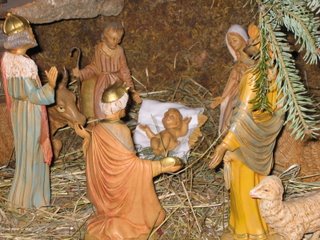
'Tis the season when manger scenes will be stolen or vandalized, retail employees will be strictly instructed how to greet the holiday shoppers, and bumper stickers enjoin the faithful to “Keep Christ in Christmas.” Stephen Colbert’s 2008 Christmas special might even be trotted out to again remind  that Xmas is a term only used by militant atheists as part of their culture war against Christianity.

With respect to the latter concern I will just say that there is nothing inherently wrong with "Xmas" . . . unless, in the mind of the user it is indeed  intended to keep Christ out of Christmas or make the term more acceptable to atheists or to the Jewish people.

In fact the use of the letter "X" to abbreviate the name of Christ has been used for hundreds of years – first example in 1551 – in religious writing, where the “X” represents a Greek “chi”, the first letter of “Christ.” In this use it is parallel to other forms like “Xtian”, “Christian.” But people unaware of the Greek origin of this "X" often mistakenly interpret Xmas as an informal shortening and many frown upon the term because it seems to them a commercial convenience that omits Christ from Christmas.

Will I use the term? Probably not much. And that grates on me as it always does when other silliness or evil co opt perfectly good words in the service of some new insanity.

Corruption

(My brother, Dave, and a coworker are currently in Indonesia. The following two blog posts are edited emails. They are lengthy but need to be read and understood by Christians who want to think and act as would Jesus Christ. Highlighting is mine).


If you live in the west, you might think you have to deal with corruption. But you ain't seen nothin’ till you travel to other parts of the world. Here are some real instances to give you an idea of the immensity of the spiritual darkness that has engulfed just one nation – the nation of Indonesia:

 ·     Imagine that you have a serious crime problem. You call the police, unless you live in Indonesia. Even if a murder has occurred, the police will favor the person who offers the biggest bribe.

·       Imagine that you are pulled over in traffic by a cop. You must have been speeding or committed some other infraction . . . unless you live where darkness reigns. It would almost always be because the police officer is low on finances and needs to "fine" you so he can pay a bill or have some extra cash.

·       Imagine that you have to go to court and stand before a judge. You expect justice to be done. But not where it is always winter and never Christmas, because when Satan makes the rules, the person with the biggest bribe always wins.

·       Imagine that you are a college student. You enroll in a course, do assignments, take exams, and get a grade. But not in a land where every vestige of good is in the process of being squelched. Here you cannot pass a course without bribing the professor repeatedly for each exam and for a final grade (even though the professor habitually either doesn't show up for class, or shows up unprepared, or dismisses class after a brief discussion about something unrelated to the content of the course).

·       Imagine that you have completed all of your college course work. You naturally expect to graduate. Not in a land where the malevolent tyrant has been eradicating hope. After completing your college course work, you still cannot graduate unless you pay a bribe to the dean.

.·       Imagine that you are a college graduate, are sincerely motivated, and want to teach school in a needy area to help the students. You will surely find a job and the government will bend over backwards to help you . . . unless you live where despicable wickedness is the rule. Here you cannot get a teaching position without bribing the local principal. One well-meaning teacher wanted to work in a school in a poor, remote area. But first she had to pay the principal $25,000 (US dollars) just to get the job. She borrowed the money from family and friends and, on her low salary, will spend the rest of her life paying it back.

·       Imagine that you rent a house, sign a lease, and even make improvements with the owner's guarantee in writing that when the lease is up you have the first right to rent the house for another period of time. Sounds secure . . . unless you live where the father of lies has written the rules. Here no document is backed by the courts (remember the judges take bribes).

·       Imagine that you are stopped at a traffic light and a motorcycle crashes into the side of your car. The cyclist is clearly guilty and must pay his own hospital bills and your car repair bills . . . unless you find yourself at the mercy of the master deceiver. Here the person with the most expensive vehicle is assumed to have the most money and must pay all of the hospital and repair bills, regardless of guilt. If you refuse to pay, a mob will assemble and will attack you.

·       Imagine that you are a pastor and your church obtains a legal building permit and construction on your church building begins. The government would never come back to you 2 years later and revoke your permit and forbid you to worship in your facility . . . unless your church is in Indonesia where, if enough neighbors complain, the government will withdraw your building permit and mobs can come and disrupt your service and beat up the pastor.

·       Imagine that there are "Christians" in Florida who are burning Korans and you, a western missionary, are appalled at such an act and think it is utterly stupid. People around you would never automatically associate you with such insanity . . . unless you live in almost any Muslim context. There every westerner is believed to be a "Christian" who walks in lockstep with the most idiotic actions that other westerners may take against Islam. For safety, you must hide in your house and wait for days for everyone to calm down before you can reappear.

·       Imagine traffic laws . . . Oh, forget that one. The only traffic law in many parts of the world is that the first vehicle to land on a piece of pavement has the right to that spot.

This is the world that Roscoe and I have been in for only 3 days and it absolutely drives us crazy. Imagine what a God of beauty, truth, and order thinks of such a place! Imagine missionaries who have intentionally moved here to devote their lives to bringing the light of the glorious Gospel of Jesus to people crippled by darkness. Some bring wives, many bring children, and they will often spend 10, 20 or even their whole ministry lives here.

The next time you need justice and it is properly meted out . . . the next time you are promised something and the promise is made good . . . the next time a government official functions with integrity . . . the next time you are rewarded fairly for your labors . . . remember a nation of 240,000,000 people who never get to have such an experience.

And remember thousands of followers of Jesus who, for centuries, have devoted their entire lives to living in such a corrupt and difficult environment because they are passionate that representatives from every nation, tribe, tongue, and people will worship the Lamb throughout eternity.