God, Make Us Desperate!

A few days ago I [Jon Bloom] listened to a sermon by a man who is preparing to lead a missionary team that will plant itself into one of the least reached nations in the world.

The most optimistic estimates of the number of indigenous Christians in this nation is less than the number of people who attend [my church] on a Sunday morning. A lot less.

Listening to him was like listening to the writer of Hebrews. This man knows what he’s getting into. He’s planted a church in this nation already. The cost to follow Jesus in this nation is high. A good week is when no one in the church has been beaten.

These brothers and sisters are experiencing a “hard struggle with sufferings” (Hebrews 10:32). There are beatings, property plunderings, heresies, divisions, and there is immorality. Most church troubles we read about in the Epistles, they have it.

Listening to this missionary left most of us American Christians wondering if we’d be able to hack it. And that’s unnerving.

The New Testament teaches us that whether or not our treasure is really in heaven is most clearly seen when it costs us our earthly treasures in order to obtain it. But American Christians live in the most prosperous nation in world history and the one in which it costs the least to be a Christian.

This environment can be deadly to faith. It allows false faith to masquerade as real very easily. And its power to dissipate zeal and energy and mission-focus and willingness to risk is extraordinary because it doesn’t come to us with a whip and a threat. It comes to us with a pillow and a promise of comfort for us and our children. The former makes us desperate for God. The latter robs our sense of desperation.

And it’s the lack of a sense of desperation for God that is so deadly. If we don’t feel desperate for God, we don’t tend to cry out to him. Love for this present world sets in subtly, like a spiritual leprosy, damaging spiritual nerve endings so that we don’t feel the erosion and decay happening until it’s too late.

So we must fast and pray for and support the suffering church in the diseases that can set in from harsh adversity. But we must also fast and pray for God to deliver us from the diseases that set in from prosperity. We need him. We can discipline ourselves in various ways. But we cannot manufacture our own desperation. Only God can make us desperate for him.

So God, whatever it takes, increase our awareness of our dependence on you in everything! Keep us desperate for you so that the deceitfulness of sin does not harden our hearts (Hebrews 3:13). In Jesus’ name, amen.

Original Jon Bloom article at Desiring God blog.

What the Book teaches matters


John Piper often speaks and writes specifically about the absolute centrality of the Word of God. This week the following was posted at www.desiringgod.org.

This fourth post in the Essential Piper Series again spotlights Piper's teaching on this theme. It comes from his sermon, "Building Our Lives on the Bible."
We are a people of the Book. We know God through the Book. We meet Christ in the Book. We see the cross in the Book. Our faith and love are kindled by the glorious truths of the Book. We have tasted the divine majesty of the Word and are persuaded that the Book is God's inspired and infallible written revelation. Therefore, what the Book teaches matters…
There is no salvation from sin and guilt and condemnation and hell apart from faith in Jesus Christ (Acts 4:12Romans 10:13-171 John 5:12). And there is no other authority besides the Scriptures to show you who Christ is and to give you his Word. So don't leave the Bible, children. Don't leave the Bible, young people. Don't neglect the Bible, dads and moms. Don't ignore the Bible, single people. Under God, the "sacred writings," the Scriptures, are the greatest treasure in the world. They alone make us wise unto salvation through Christ. O don't neglect this Book!

The post stands on its own. However, it is well worth your while to click on "Building Our Lives on the Biblefor the full text of the message.

Bonhoeffer Redux

It is the 65th anniversary year of the Nazi execution of Detrich Bonhoeffer. He died by hanging on April 9, 1945 at the Flossenburg Concentration Camp  for his part in a plot to assassinate Hitler. He was 39.

Bonhoeffer: Pastor, Martyr, Prophet, Spy (April 2010, Thomas Nelson), by Eric Metaxas, was selected by World Magazine as Runner-Up Book of the Year. You can read my earlier blog entry: Bonhoeffer: A Conscience Captive to the Word of God.

This is without a doubt in the list of the top five books that I have ever bought or read.

See the World Magazine review at

 I hope you will buy it also. 

Bonhoeffer - A Conscience Captive to the Word of God

Now I know better, my early training notwithstanding. How I regret having never questioned the then prevailing notion that Dietrich Bonhoeffer was one of the theological bad guys - not only was he supposedly suspect as to orthodoxy but actually an enemy of the Gospel. Thankfully, it is not too late to profit from the life and writings of this man of God.

Truly, if ever a man spoke with a "conscience captive to the Word of God" (M. Luther) - it was
 Bonhoeffer: Pastor, Martyr, Prophet, Spy. This is the title of the very revealing and moving new book by Eric Metaxas (also the author of the seminal Amazing Grace: William Wilberforce and the Heroic Campaign to End Slavery).

Metaxas' work is sorely needed, not just for me but for so many others who have been misinformed. Bonhoeffer dared to criticize the politicized cultural "Christianity" of Hitler's Germany (primarily the unbiblical "religious" legalism, fomalism, and Nazi compromise). Metaxas emphasizes - and proves - that Bonhoeffer was not, as some have said, a liberal Christian opposing genuine Christianity. Unfortunately, some English-speaking interpreters of his German letters have unjustly distorted his prison-letters and taken certain phrases -- such as "religionless christianity" -- out of context. To see his genuine love for the whole, unabridged Word of God, please see Bonhoeffer's little booklet, Life Together. 

Kevin Williamson wrote in the Wall Street Journal: "Bonhoeffer’s is a story that the most imaginative novelist could not have invented." I can tell you that it actually does read like a novel while also opening up that darkest of times; after all these years his descriptions still stretch credulity: How could these things have ever happened? How could such people exist in a civilized world and how could so many have been deceived? And how is it possible that so many died the grisley and horrific deaths that they died?

But more to the point, how could such a man as Bonhoeffer come to be? And how could he - or anyone - stand as he did against the tidal wave of National Socialism? He was often alone, and very often at odds with the Nazi controlled German Christians Church, misunderstood and doubted even by his own Confessing Church?

This is a book that is "unputdownable", but one that you eventually do have to stop reading, if only because it is well-over 500 pages long! But 500-plus gripping and inspiring pages they are. And besides that, with mind and emotions in overload, the only thing that one can do sometimes is set it aside. For me that was often to turn to the Word of God, to meditate, and to pray.

Bonhoeffer's best known work is The Cost of Discipleship. In the beginning of the 1963 Macmillan paperback edition there is a "Memoir" written by G. Leibholz." In it he describes Bonhoeffer's faith and martyrdom. Here is an edited version which includes some quotations directly from Discipleship:

Memoir

"In his hearing before the Gestapo during his imprisonment, defenseless and powerless as he then was, only fortified by the word of God in his heart, he stood erect and unbroken before his tormentors. He refused to recant, and defied the Gestapo machine by openly admitting that, as a Christian, he was an implacable enemy of National Socialism and its totalitarian demands toward the citizen—defied it, although he was continually threatened with torture and with the arrest of his parents, his sisters and his fiancĂ©e… In 1944, when friends made an attempt to liberate him and to take him to safety abroad, he decided to remain in prison in order not to endanger others.

"The last service which Dietrich Bonhoeffer held on the day before his death... 'moved all deeply....' Every Nazi inflicted death was calculated to be gruesome; Bonhoeffer's was no different when stripped naked he put his head in a noose of piano wire. "Bonhoeffer, who was never tried, went steadfastly on his last way to be hanged, and died with admirable calmness and dignity. God heard his prayer and granted him the 'costly grace'—that is, the privilege of taking the cross for others and of affirming his faith by martyrdom."

"How can a man wax arrogant if in this life he shares the suffering of God?" 

"Both modern liberal theology and secular totalitarianism hold pretty much in common that the message of the Bible has to be adapted more or less, to the requirements of a secular world. No wonder, therefore, that the process of debasing Christianity as by liberal theology led, in the long run, to a complete perversion and falsification of the essence of Christianity...." 

A Christian must be prepared, if necessary, to offer his life for this. Thus all kinds of secular totalitarianism which force man to cast aside his religious and moral obligations to God and subordinate the laws of justice and morality to the State are incompatible with his conception of life.…"

"The life of the spirit is not that which shuns death and keeps clear of destruction: rather it endures death and in death it is sustained. It only achieves its truth in the midst of utter destruction."

"In a modern dictatorship, however, with its subterranean ubiquity and all-embracing instruments of oppression, a revolt means certain death to all who support it. ... The future in modern society depends much more on the quiet heroism of the very few who are inspired by God. These few will greatly enjoy the divine inspiration and will be prepared to stand for the dignity of man and true freedom and to keep the law of God, even if it means martyrdom or death--

"… because they 'look not at the things which are seen, but at the things which are unseen; for the things which are seen /are temporal, but the things that are unseen are eternal." [2 Cor. 4:17-18, 33-34]

"Jesus invites all those that labor and are heavy laden, and nothing could be so contrary to our best intentions, and so fatal to our proclamation  as to drive men away from him by forcing upon them man-made dogmas. If we did so, we should make the love of Jesus Christ a laughing-stock to Christians and pagans alike."

----------------------------------

Please read the book. I would loan you mine but I got it at the library.


Joel Osteen and the Glory Story

Joel Osteen and those who are like-minded continue to deliver a counterfeit gospel that baffles untaught believers, confuses everyone else, while reaping monstrous personal profits. We cannot but be concerned for his soul and for the eternal consequences for all those who advance such deliberate deceptions. These teachings are manifestly far fetched; they do not yield to even basic logic and even superficial comparisons with God's Word serve to expose the error.

Please follow the link to Dr. Michael Horton's article: Joel Osteen and the Glory Story: A Case Study.

Again, the answer to all this - Receive the Word!

"How few there are who die so hard."

The Difficult Death of Adoniram Judson

Yesterday (April 12, 2010) marked the 160th anniversary of the death of Adoniram Judson, America's first foreign missionary. For 38 years—through imprisonment, torture, illness, deep depression, isolation from family and friends, and the loss of two wives and numerous children—he suffered to bring the gospel to the unreached peoples of Burma.


At age 61 he fell ill for the last time. John Piper recounts those final days:
The only hope was to send the desperately ill Judson on a voyage. On April 3, 1850 they carried Adoniram onto the Aristide Mariebound for the Isle of France with one friend, Thomas Ranney, to care for him. In his misery he would be roused from time to time by terrible pain ending in vomiting. One of his last sentences was: "How few there are who . . . who die so hard!"
At 15 minutes after 4 on Friday afternoon April 12, 1850 Adoniram Judson died at sea, away from all his family and Burmese Church. That evening the ship hove to.
"The crew assembled quietly. The larboard port was opened. There were no prayers. . . . The captain gave the order. The coffin slid through the port into the night" (To the Golden Shore, p. 505).
He died in obscurity, but to this day the fruit of Judson's life and death proves the promise Jesus gave in John 12:24: "Truly, truly, I say to you, unless a grain of wheat falls into the earth and dies, it remains alone; but if it dies, it bears much fruit." As Piper observes,
Today it is estimated that the Myanmar (Burma's new name) Baptist Convention to be 3,700 congregations with 617,781 members and 1,900,000 affiliates—the fruit of [Judson's] dead seed.
What significance does this have for us today? Piper asks the hard question, especially of pastors:
Are you sure that God wants you to be a pastor in this comparatively church-saturated land? Or might he be calling you to fill up what is lacking in the sufferings of Christ, to fall like a grain of wheat into some distant ground and die, to hate your life in this world and so to keep it forever and bear much fruit?
[...]
The question, brothers, is not whether we will die, but whether we will die in a way that bears much fruit.
* * *
Read or listen to the rest of John Piper's biography of Judson.

"I Never Made A Sacrifice"


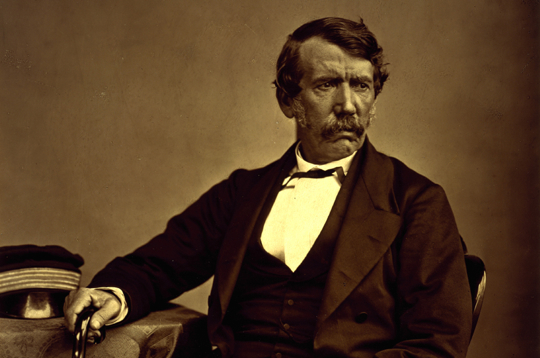
David Livingstone
Today is David Livingstone’s birthday. He was born March 19, 1813. He gave his life to serve Christ in the exploration of Africa for the sake of the gospel.
On December 4, 1857, he spoke the sentence that has made the greatest impact on me. It is one of the clearest applications I have seen of Jesus’ words in Mark 10:29-30. Jesus said,
Truly, I say to you, there is no one who has left house or brothers or sisters or mother or father or children or lands, for my sake and for the gospel, who will not receive a hundredfold now in this time, houses and brothers and sisters and mothers and children and lands, with persecutions, and in the age to come eternal life.
Here is what Livingstone said to the Cambridge students about his “leaving” the benefits of England:
For my own part, I have never ceased to rejoice that God has appointed me to such an office. People talk of the sacrifice I have made in spending so much of my life in Africa. . . . Is that a sacrifice which brings its own blest reward in healthful activity, the consciousness of doing good, peace of mind, and a bright hope of a glorious destiny hereafter? Away with the word in such a view, and with such a thought! It is emphatically no sacrifice. Say rather it is a privilege. Anxiety, sickness, suffering, or danger, now and then, with a foregoing of the common conveniences and charities of this life, may make us pause, and cause the spirit to waver, and the soul to sink; but let this only be for a moment. All these are nothing when compared with the glory which shall be revealed in and for us. I never made a sacrifice.
(Cited in Samuel Zwemer, "The Glory of the Impossible" in Perspectives on the World Christian Movement, Ralph Winter and Stephen Hawthorne, eds. [Pasadena: William Carey Library, 1981], p. 259. Emphasis added.