John Piper gave an 18 minute talk a Lausanne on the importance of the Bible. View and listen here:
"I cannot control such a God."
From Chapter 9 of Reaching for the Invisible God by Philip Yancey.
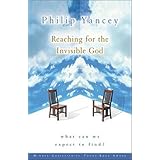 I have learned one absolute principle in calculating God's presence or absence, and that is that I cannot. God, invisible, sovereign, who according to the psalmist "does whatever pleases him," sets the terms of the relationship. As the theologian Karl Barth insisted so fiercely, God is free: free to reveal himself or conceal himself, to intervene or not intervene, to work within nature or outside it, to rule over the world or even to be despised and rejected by the world, to display himself or limit himself. Our own human freedom derives from a God who cherishes freedom.
I cannot control such a God. At best I can put myself in the proper frame to meet him. I can confess sin, remove hindrances, purify my life, wait expectantly, and - perhaps hardest of all - seek solitude and silence. I offer no guaranteed method to obtain God's presence, for God alone governs that. Solitude and silence merely supply the state most conducive to attending to the still, small voice of God. There is, however, a sure way to promote God's absence. C. S. Lewis sets it out clearly: "Avoid silence, avoid solitude, avoid any train of thought that leads off the beaten track. Concentrate on money, sex, status, health, and (above all) on your own grievances. Keep the radio on. Live in a crowd. Use plenty of sedation. If you must read books, select them carefully. But you'd be safer to stick to the papers. You'll find the advertisements helpful; especially those with a sexy or a snobbish appeal."
Lewis adds that he cannot give advice on pursuing God, having never had that experience. "It was the other way round; He was the hunter (or so it seemed to me) and I was the deer ... But it is significant that this long-evaded encounter happened at a time when I was making a serious effort to obey my conscience."
I have learned one absolute principle in calculating God's presence or absence, and that is that I cannot. God, invisible, sovereign, who according to the psalmist "does whatever pleases him," sets the terms of the relationship. As the theologian Karl Barth insisted so fiercely, God is free: free to reveal himself or conceal himself, to intervene or not intervene, to work within nature or outside it, to rule over the world or even to be despised and rejected by the world, to display himself or limit himself. Our own human freedom derives from a God who cherishes freedom.I cannot control such a God. At best I can put myself in the proper frame to meet him. I can confess sin, remove hindrances, purify my life, wait expectantly, and - perhaps hardest of all - seek solitude and silence. I offer no guaranteed method to obtain God's presence, for God alone governs that. Solitude and silence merely supply the state most conducive to attending to the still, small voice of God. There is, however, a sure way to promote God's absence. C. S. Lewis sets it out clearly: "Avoid silence, avoid solitude, avoid any train of thought that leads off the beaten track. Concentrate on money, sex, status, health, and (above all) on your own grievances. Keep the radio on. Live in a crowd. Use plenty of sedation. If you must read books, select them carefully. But you'd be safer to stick to the papers. You'll find the advertisements helpful; especially those with a sexy or a snobbish appeal."
Lewis adds that he cannot give advice on pursuing God, having never had that experience. "It was the other way round; He was the hunter (or so it seemed to me) and I was the deer ... But it is significant that this long-evaded encounter happened at a time when I was making a serious effort to obey my conscience."
The Influence of Excitement
 There are some wonderful instances of ordinary Christians, not least the young, who are concerned to preach the whole gospel unabashedly and do good first to the household of God and then, as much as is possible, outside as well. That has got biblical mandate behind it. . . .
My warning would be to those who are coming along and talking a lot about, “I want to be faithful to the gospel, but I also want to do social justice and good works.” My warning would be: it is not just what you do, it is what you are excited about.
If I have learned anything in 35 or 40 years of teaching, it is that students don’t learn everything I teach them. What they learn is what I am excited about, the kinds of things I emphasize again and again and again and again. That had better be the gospel.
If the gospel—even when you are orthodox—becomes something which you primarily assume, but what you are excited about is what you are doing in some sort of social reconstruction, you will be teaching the people that you influence that the gospel really isn’t all that important. You won’t be saying that—you won’t even mean that—but that’s what you will be teaching. And then you are only half a generation away from losing the gospel.
Make sure that in your own practice and excitement, what you talk about, what you think about, what you pray over, what you exude confidence over, joy over, what you are enthusiastic about is Jesus, the gospel, the cross. And out of that framework, by all means, let the transformed life flow. (Boldfaced text is my emphasis).
– Don Carson, lecture, “Is the Culture Shaping Us or are We Shaping the Culture?” delivered at the CBMW Different By Design Conference (Feb. 2, 2009, Minneapolis, MN)..
This Is Priceless!
 Failure and Success: Not Measuring Up
AW Tozer
Therefore, my beloved brethren, be steadfast, immovable, always abounding in the work of the Lord, knowing that your labor is not in vain in the Lord. --1 Corinthians 15:58
It is good to come to the understanding that while God wants us to be holy and Spirit-filled, He does not expect us to look like Abraham or to play the harp like David or to have the same spiritual insight given to Paul.
All of those former heroes of the faith are dead. You are alive in your generation. A Bible proverb says that it is better to be a living dog than a dead lion. You may wish to be Abraham or Isaac or Jacob, but remember that they have been asleep for long centuries, and you are still around! You can witness for your Lord today. You can still pray. You can still give of your substance to help those in need. You can still encourage the depressed.
I hope you have not missed something good from God's hand because you felt you did not measure up to Gideon or Isaiah. In this your generation, give God all of your attention! Give Him all of your love! Give Him all of your devotion and faithful service! You do not know what holy, happy secret God may want to whisper to your responsive heart.
"Father, I commit myself to faithfulness today. I don't have the great gifts of these 'former heroes of the faith.' But You've given me life today; You've given me the gifts You want me to have and use; You've called me by Your grace to serve You. I give it all to You today. Amen."
Jesus, Author of our Faith, 72.
"But to deviate from the truth . . .
. . . for the sake of some prospect of hope of our own can never be wise, however slight that deviation may be. It is not our judgment of the situation which can show us what is wise, but only the truth of the Word of God. Here alone lies the promise of God's faithfulness and help. It will always be true that the wisest course for the disciple is always to abide solely by the Word of God in all simplicity."
-- Dietrich Bonhoeffer, quoted by Eugene Peterson in
A Long Obedience In the Same Direction, page 36.
A Long Obedience In the Same Direction, page 36.
Would Jesus Use Facebook? Probably.
With a predictably mixed response to yesterday's blog post I am encouraged with the following from the writings of A. W. Tozer. It reminds me that there are indeed things that matter and then there are things that don't matter at all. What I said yesterday, and maintain today, is that for ME, social networking represents one of the choices to be made in "our painfully intricate civilization". And for ME it is one of those things that "unless [I] get out from under them, they will crush [me] body and soul." After all is said and done, the question, "Would Tozer use Facebook?" or for that matter, "Would Jesus?" might well be answered, "ummmmm . . . probably."
Here's the quotation from Failure and Success: The Things That Matter.
...that you may approve the things that are excellent, that you may be sincere and without offense till the day of Christ, being filled with the fruits of righteousness which are by Jesus Christ, to the glory and praise of God. --Philippians 1:10-11
In life there will be found certain great fundamentals, like pillars bearing up the weight of some mighty building....
The wise man will simplify his life by going to the center of it. He will look well to the foundations and, having done that, he will not worry about the rest.
Life as we know it in our painfully intricate civilization can be deadly unless we learn to distinguish the things that matter from those that do not. It is never the major things that destroy us, but invariably the multitude of trifling things which are mistakenly thought to be of major importance. These are so many that, unless we get out from under them, they will crush us body and soul....
Every believer as well as every minister of Christ must decide whether he will put his emphasis upon the majors or the minors. He must decide whether he will stay by the sober truths which constitute the beating heart of the Scriptures or turn his attention to those marginal doctrines which always bring division and which, at their best, could not help us much on our way to the Celestial City. The Next Chapter After the Last, 11,14.
"Oh God, we are so inundated with distracting things and clamorous voices. Deliver me today from the trifling things and help me to spend every minute of the day on 'the things that matter.' Amen.
Here's the quotation from Failure and Success: The Things That Matter.
...that you may approve the things that are excellent, that you may be sincere and without offense till the day of Christ, being filled with the fruits of righteousness which are by Jesus Christ, to the glory and praise of God. --Philippians 1:10-11
In life there will be found certain great fundamentals, like pillars bearing up the weight of some mighty building....
The wise man will simplify his life by going to the center of it. He will look well to the foundations and, having done that, he will not worry about the rest.
Life as we know it in our painfully intricate civilization can be deadly unless we learn to distinguish the things that matter from those that do not. It is never the major things that destroy us, but invariably the multitude of trifling things which are mistakenly thought to be of major importance. These are so many that, unless we get out from under them, they will crush us body and soul....
Every believer as well as every minister of Christ must decide whether he will put his emphasis upon the majors or the minors. He must decide whether he will stay by the sober truths which constitute the beating heart of the Scriptures or turn his attention to those marginal doctrines which always bring division and which, at their best, could not help us much on our way to the Celestial City. The Next Chapter After the Last, 11,14.
"Oh God, we are so inundated with distracting things and clamorous voices. Deliver me today from the trifling things and help me to spend every minute of the day on 'the things that matter.' Amen.
[Anti]Social Networking
I begin here to list reasons I no longer use Facebook. I think these would apply to Twitter, MySpace and other social networking instruments although I have never used them. In any case, this is my own list (not a judgement on anyone else) although it could possibly help to guide - and even guard - others.
1. James 4:14 - For what is your life? It is even a vapor that appears for a little time and then vanishes away. Computers can take over one's entire life and all too easily. I know enough about myself to be wary. I don't need an easy reason to spend more time at the computer. Somehow I think that, Life consisteth not in the abundance of [Facebook Friends] one possesseth (loose paraphrase of Luke 12:15).
2.1Cointhains 10:23 and 6:12 - All things are lawful for me, but all things are not expedient: all things are lawful for me, but all things edify not. All things are lawful unto me, but all things are not expedient: all things are lawful for me, but I will not be brought under the power of any. Facebook is for me - and others - but certainly for me, habit-forming if not addictive. And, "that which I cherish is either an idol or an offering." Two issues here: lack of discipline and idolatry.
3. John 3:30 - He must become greater and greater, and I must become less and less. For me, Facebook is too easily the gasoline that ignites the spark of self - "me, myself, and I". As Josh Harris put it: " I found that [Facebook] encouraged me to think about me even more than I already do–which is admittedly already quite a bit. Without any help from the internet I’m [already] inclined to give way too much time to evaluating myself, thinking about myself and wondering what other people think of me. If that egocentrism is a little flame, than Facebook for me is a gasoline IV feeding the fire. I need to grow in self-forgetfulness. I need to worry more about what God is thinking of me. I need to be preoccupied with what he’s written in his word, not what somebody just wrote on my “wall.”
4. If our brains really do have plasticity and are molded in their processes by the tools that we use, then I certainly don't need something else that has me thinking in "sound bytes" and short little bursts of data. Most media and the internet have retooled our minds - rebooted our mental hard drives - so that we neither concentrate nor contemplate as we have and ought. (Nicholas Carr. The Shallows. Neither do we do it nor can we even if we try. Try sitting down and reading a book for two hours or even an hour or even 15 minutes without squirming and itching to check email or in this case, Facebook. I am conscious that having put this on my blog, you will be one of the few that have read this far - skimed it maybe, but not read it - simply because it's too long and most cannot concentrate that long.
5. Ephesians 5:3, 4 - . . . let it not even be named among you, as is fitting for saints; . . . nor foolish talking, nor coarse jesting, which are not fitting, but rather giving of thanks. Unless every "Friend" is oriented to Ephesians 5 and Philippians 4:8 very few set as a benchmark for their posts, "think on these things". Meaning then that it can be and often is a magnet for the filthy and the foul; at the least, inanity, shallowness, superficiality, baloney becomes characteristic. Whether writes it himself or invites or engages in such himself, it is still difficult to police, ignore, or hide others.
6. I resist redefinition of English words and phrases - "friend" for example. Someone has written: "As the saying goes, you are lucky if you have two friends who you can completely trust. Most people on Facebook have over a hundred "friends". By using the term to apply to every most casual acquaintance, we devalue its meaning and encourage fleeting superficial relationships. Friends are about quality, not quantity. Facebook friends accumulation is like checking who caught more fish." Someone has identified a significant number of people with this concern. It is called a fear of an Orwellesque Deterioration of Language. But on top of this, English teachers are tearing their hair out at what texting has done to a young person's ability to spell. And that pales next to other linguistic atrocities. Every time I turn around another noun has been turned into a verb - sourced, if you will. Tell me that this does not impact our language, and I've just referenced two examples (or is it three)?
7. True communication is multi-level and one of those levels is the non-verbal level. They say that 80% of communication happens through body language and facial expressions. I miss out on all that with you if you are just a Friend on Facebook..
8. I have seen the incredulity and felt the scorn of those who learn of my general aversion to the Net and to Facebook especially. And people actually get mad at me - or think I am some nutty Luddite - because I try not to check my email out of the office. This kind of thing confirms my suspicions, hardens my resistance, and prove at least to me how questionable the whole thing is.
9. If nothing else, I would have questions about Facebook because of the circumstances under which it was created, the reasons it was created, and the kind of person who created it. Can any good thing come out of that moral and misogynistic mishmash? At what point was it suddenly redeemed? Did I miss something?
10. Bottom line: the charge from Proverbs 4- Guard your heart above all else, for it determines the course of your life.
Is Google Making Us Stupid? An article in The Atlantic by Nicholas Carr
1. James 4:14 - For what is your life? It is even a vapor that appears for a little time and then vanishes away. Computers can take over one's entire life and all too easily. I know enough about myself to be wary. I don't need an easy reason to spend more time at the computer. Somehow I think that, Life consisteth not in the abundance of [Facebook Friends] one possesseth (loose paraphrase of Luke 12:15).
2.1Cointhains 10:23 and 6:12 - All things are lawful for me, but all things are not expedient: all things are lawful for me, but all things edify not. All things are lawful unto me, but all things are not expedient: all things are lawful for me, but I will not be brought under the power of any. Facebook is for me - and others - but certainly for me, habit-forming if not addictive. And, "that which I cherish is either an idol or an offering." Two issues here: lack of discipline and idolatry.
3. John 3:30 - He must become greater and greater, and I must become less and less. For me, Facebook is too easily the gasoline that ignites the spark of self - "me, myself, and I". As Josh Harris put it: " I found that [Facebook] encouraged me to think about me even more than I already do–which is admittedly already quite a bit. Without any help from the internet I’m [already] inclined to give way too much time to evaluating myself, thinking about myself and wondering what other people think of me. If that egocentrism is a little flame, than Facebook for me is a gasoline IV feeding the fire. I need to grow in self-forgetfulness. I need to worry more about what God is thinking of me. I need to be preoccupied with what he’s written in his word, not what somebody just wrote on my “wall.”
4. If our brains really do have plasticity and are molded in their processes by the tools that we use, then I certainly don't need something else that has me thinking in "sound bytes" and short little bursts of data. Most media and the internet have retooled our minds - rebooted our mental hard drives - so that we neither concentrate nor contemplate as we have and ought. (Nicholas Carr. The Shallows. Neither do we do it nor can we even if we try. Try sitting down and reading a book for two hours or even an hour or even 15 minutes without squirming and itching to check email or in this case, Facebook. I am conscious that having put this on my blog, you will be one of the few that have read this far - skimed it maybe, but not read it - simply because it's too long and most cannot concentrate that long.
5. Ephesians 5:3, 4 - . . . let it not even be named among you, as is fitting for saints; . . . nor foolish talking, nor coarse jesting, which are not fitting, but rather giving of thanks. Unless every "Friend" is oriented to Ephesians 5 and Philippians 4:8 very few set as a benchmark for their posts, "think on these things". Meaning then that it can be and often is a magnet for the filthy and the foul; at the least, inanity, shallowness, superficiality, baloney becomes characteristic. Whether writes it himself or invites or engages in such himself, it is still difficult to police, ignore, or hide others.
6. I resist redefinition of English words and phrases - "friend" for example. Someone has written: "As the saying goes, you are lucky if you have two friends who you can completely trust. Most people on Facebook have over a hundred "friends". By using the term to apply to every most casual acquaintance, we devalue its meaning and encourage fleeting superficial relationships. Friends are about quality, not quantity. Facebook friends accumulation is like checking who caught more fish." Someone has identified a significant number of people with this concern. It is called a fear of an Orwellesque Deterioration of Language. But on top of this, English teachers are tearing their hair out at what texting has done to a young person's ability to spell. And that pales next to other linguistic atrocities. Every time I turn around another noun has been turned into a verb - sourced, if you will. Tell me that this does not impact our language, and I've just referenced two examples (or is it three)?
7. True communication is multi-level and one of those levels is the non-verbal level. They say that 80% of communication happens through body language and facial expressions. I miss out on all that with you if you are just a Friend on Facebook..
8. I have seen the incredulity and felt the scorn of those who learn of my general aversion to the Net and to Facebook especially. And people actually get mad at me - or think I am some nutty Luddite - because I try not to check my email out of the office. This kind of thing confirms my suspicions, hardens my resistance, and prove at least to me how questionable the whole thing is.
9. If nothing else, I would have questions about Facebook because of the circumstances under which it was created, the reasons it was created, and the kind of person who created it. Can any good thing come out of that moral and misogynistic mishmash? At what point was it suddenly redeemed? Did I miss something?
10. Bottom line: the charge from Proverbs 4- Guard your heart above all else, for it determines the course of your life.
Is Google Making Us Stupid? An article in The Atlantic by Nicholas Carr
Subscribe to:
Posts (Atom)